
The last normal night before the block — go to bed at your usual time.

Night shift sleep planner
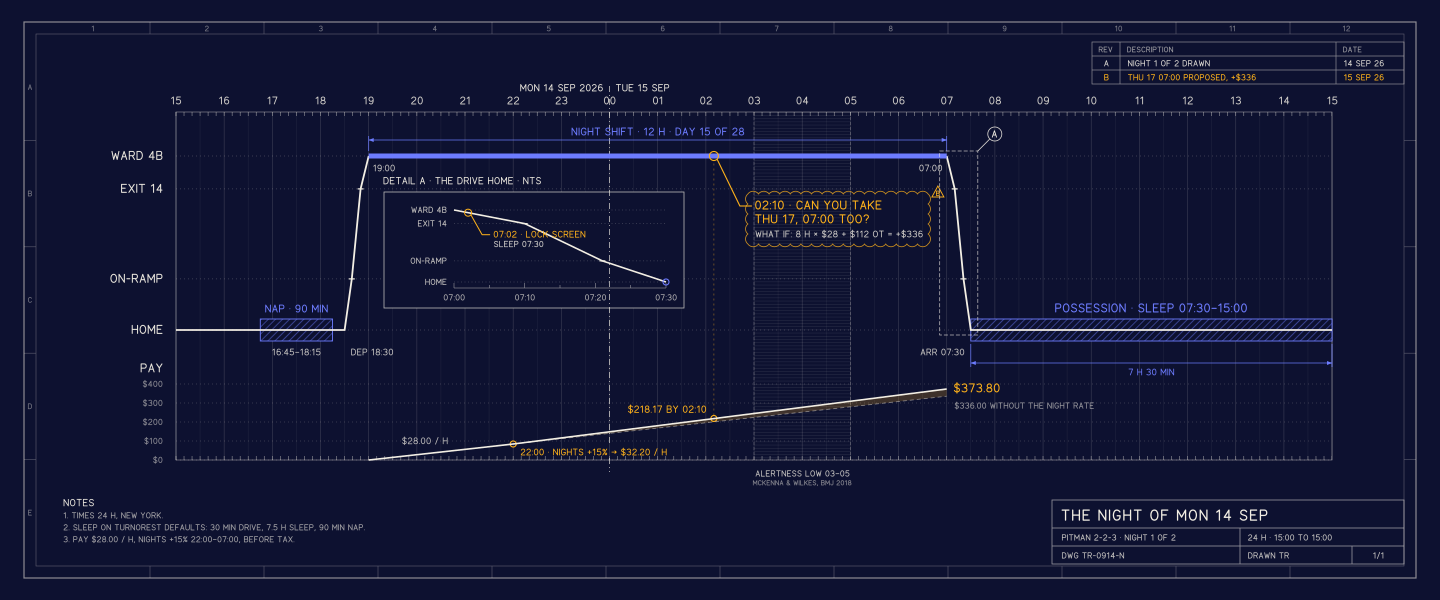
Two 7 PM–7 AM nights in a row, 30 minutes from home. This is where the sleep goes, and TurnoRest plans it the same way around every night on your calendar, for free.
7:30 AM–3 PM
Straight after the night, then a 90-minute nap before you go back. Plan your own nights.

Your run of nights
Sleep between two nights
7:30 AM–3 PM
3 nights in a row, and 38.5 hours of sleep on the chart below, naps included.
No rest warnings
These days pass all five rest checks.
Where these limits are law
In the United States there is no federal limit on working hours and no mandatory minimum rest for most workers: the FLSA requires overtime pay above 40 hours, not that you avoid them. Some states have their own rules, particularly for nursing. The app’s thresholds come from NIOSH’s training for nurses — 11 h between shifts, 40 h a week, 12 h per shift, and 60 h in 7 days, the last two from the Institute of Medicine — and from expert recommendations for the 3 consecutive nights. The critical thresholds for rest (8 h), nights (5th), and shift length (14 h), and the full day off every 7 days, are convention. They’re a signal for you, not a legal obligation on your employer.
In TurnoRest this plan is free and follows your real schedule, with a reminder 30 minutes before each window and the window on your Lock Screen widget.
Try your own nights
Sleep between two nights7:30 AM–3 PMSee the nightsDay by day in the app’s words
- MonNight 1 of 37 PM–7 AM
SleepSun 11 PM–6:30 AM7 h 30 min Nap4:45 PM–6:15 PM1 h 30 min First night of the block: sleep normally the night before and take a long nap before your shift.
Up for 10 h 15 min before it15 min from waking to leaving
This nap is optional. Skip it if you’d rather have time for a shower and a meal, or set a longer commute in the app’s Settings › Sleep and it moves earlier.
First night of the block: your body clock won’t fully adapt in a few days — the goal is to start without sleep debt. McKenna & Wilkes 2018, BMJSmith & Eastman 2012NIOSH 2015
- TueNight 2 of 37 PM–7 AM
Sleep7:30 AM–3 PM7 h 30 min Go to bed as soon as you get home — later on, your body clock and daylight try to keep you awake.
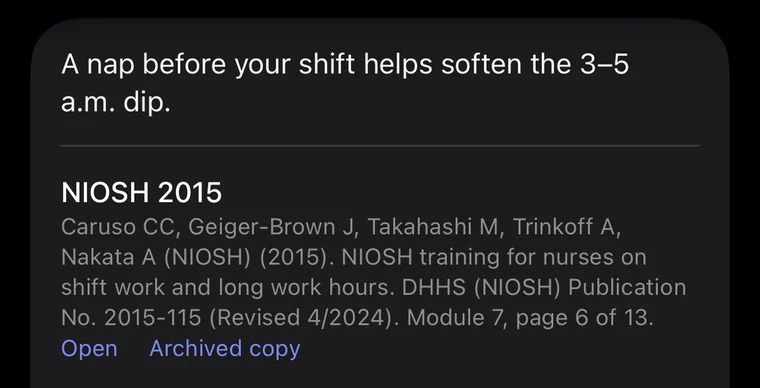
Nap4:45 PM–6:15 PM1 h 30 min A nap before your shift helps soften the 3–5 a.m. dip.
Up for 1 h 45 min before it15 min from waking to leaving
- WedNight 3 of 37 PM–7 AM
Sleep7:30 AM–3 PM7 h 30 min Go to bed as soon as you get home — later on, your body clock and daylight try to keep you awake.
Nap4:45 PM–6:15 PM1 h 30 min A nap before your shift helps soften the 3–5 a.m. dip.
Up for 1 h 45 min before it15 min from waking to leaving
- ThuDay off
Recovery7:30 AM–11:30 AM4 h After the last night, sleep for only part of the day — it makes it easier to fall asleep at your usual time.
Sleep11 PM–6:30 AM7 h 30 min Day off: anchored to your usual bedtime.
Last night of the block: keep your morning sleep short and go to bed at your usual time. McKenna & Wilkes 2018, BMJSmith & Eastman 2012NIOSH 2015
- FriDay off
Sleep11 PM–6:30 AM7 h 30 min Day off: anchored to your usual bedtime.
TurnoRest is not a medical device and this is not medical advice. The windows are a plan built from a schedule and published guidance; they don’t measure your sleep. If tiredness doesn’t go away, talk to a doctor.
How the plan is made
The rules below are the app’s own, with the numbers it uses. Where a number is TurnoRest’s choice rather than a source’s, it says so.
Every window leaves room for the drive
No window touches a shift or the commute on either side of it, 30 minutes each way unless you change it. A window cut down to 20 minutes or less is dropped, and two windows never overlap: the shorter one gives way, and a nap gives way in whole 90-minute cycles so you still wake at the end of one.
Straight to bed between two nights
After a night that ends at 7 AM, sleep starts when you’re home: 7:30 AM–3 PM. NIOSH’s training for nurses says go to bed right away, because later in the morning your body clock and daylight work to keep you awake (NIOSH 2015, Smith & Eastman 2012). One lab study found that starting day sleep a few hours later didn’t shorten it (Sargent et al. 2022), and the app shows it next to the tip.
A nap before you go back
A 90-minute nap that ends shortly before you leave: 4:45 PM–6:15 PM on a 7 PM start. The evidence is strongest for the one before the first night; between two nights the plan puts one in too, and it is tight: 1 h 45 min awake before it and 15 min to get out of the door. NIOSH’s training notes that waking from a nap can leave you groggy for a while, so a short gap before you drive matters. In the American Academy of Sleep Medicine’s guideline, planned naps are the night-shift measure with the strongest recommendation (AASM 2007). The BMJ’s review puts the low point of alertness between 3 and 5 AM (McKenna & Wilkes 2018, BMJ); a nap softens it and doesn’t remove it (Smith & Eastman 2012).
The first night starts with a normal one
Before the first night the plan keeps your usual bedtime, Sun 11 PM–6:30 AM, then the long nap in the afternoon. NIOSH warns against staying up all day before a first night (NIOSH 2015), and in a small lab study people who slept at night and napped did no worse on the first night than the second (Kosmadopoulos et al. 2016). Early risers slept less when the main sleep was pushed later (Reiter et al. 2023).
Only part of the day after the last night
A recovery sleep of 4 hours, 7:30 AM–11:30 AM, then bed at 11 PM so the next night is a normal one (McKenna & Wilkes 2018, BMJ). The 4 hours are TurnoRest’s own choice: no source gives that length, and the app labels it that way.
Day shifts are counted back from leaving
Before a day shift, sleep is 7.5 hours counted back from when you leave home: the start, minus the commute, minus 45 minutes to get ready. It never starts later than 11 PM. When two shifts leave less than 5 hours for sleep, the window becomes a recovery window and says there isn’t time for a full night. That’s arithmetic, so it cites nothing.
Where the defaults come from
7.5 hours sits inside what NIOSH (about 7 to 8) and the AASM and Sleep Research Society (7 or more) give for adults (AASM & SRS 2015). 90 minutes is about one sleep cycle, and NIOSH notes that waking at the end of one can leave you less groggy (NIOSH 2015). You can change all three in the app’s Settings › Sleep, and here.
Where each rest warning comes from
Five checks run on every schedule. Where you work changes the document behind each one and whether it’s law there. The critical levels are TurnoRest’s convention unless a source is named.
- Rest between shiftsWarning: under 11 hCritical: under 8 h
US NIOSH (Knauth & Hornberger)At least 11 h between shifts
UK Working Time Regulations 1998, reg. 1011 h daily rest
- A full day off every weekCritical: 7 days without 24 h off
US NIOSHPlan 1–2 full days off after 5 × 8 h or 4 × 10 h shifts; consider 2 days after 3 × 12 h shifts. 24 h threshold: convention, not published in this source
UK Working Time Regulations 1998, reg. 1124 h weekly rest
- Nights in a rowWarning: night 4Critical: night 5 on
US, UK Consecutive nightsRecommended maximum: 3 (Garde et al. 2020; UK HSE: 2–3)
- Shift lengthWarning: over 12 hCritical: over 14 h
US, UK Long shiftsUp to 12 h in 24 h (Institute of Medicine, as cited by NIOSH; UK HSE)
- Hours in any 7 daysWarning: over 40 h in the US, 48 h in the UKCritical: over 60 h
US NIOSH (nursing)More than 40 h a week is linked to worse outcomes
UK Working Time Regulations 1998, reg. 448 h weekly average (opt-out available)
In most of the United States there’s no federal limit on hours and no required rest between shifts; overtime law makes hours cost more but doesn’t cap them. The app’s warnings name their source and say when it isn’t law where you work.
Every source
Each citation was opened and the sentence checked against the page on September 17, 2026. Studies that limit the advice are listed too, next to the ones that back it.
All 21 sources, with what each one backs
Guidance, consensus and law
- UK HSEGood practice guidelines (Human factors — shift work)
Backs nights in a row, long shifts.
- Working Time Regulations 1998The Working Time Regulations 1998
Backs rest between shifts, a day off every week, hours in 7 days.
- Institute of Medicine 2004Keeping Patients Safe: Transforming the Work Environment of Nurses
Backs more than 60 h in 7 days, long shifts.
- AASM 2007Practice parameters for the clinical evaluation and treatment of circadian rhythm sleep disorders
Backs the nap before a night, planned naps.
- AASM & SRS 2015Recommended Amount of Sleep for a Healthy Adult: A Joint Consensus Statement of the American Academy of Sleep Medicine and Sleep Research Society
Backs 7.5 h of sleep and a 90-minute nap.
- NIOSH 2015NIOSH training for nurses on shift work and long work hours
Backs sleep straight after a night, the nap before a night, the long nap before the first night, 7.5 h of sleep and a 90-minute nap, the last normal night, the first night of a block, the short sleep after the last night, the last night of a block, planned naps, rest between shifts, a day off every week, hours in 7 days, more than 60 h in 7 days, long shifts. Qualifies long shifts.
Module 2, page 8Module 5, page 5Module 5, page 6Module 5, page 7Module 7, page 1Module 7, page 5Module 7, page 6Module 9, page 5Module 9, page 6
- McKenna & Wilkes 2018, BMJOptimising sleep for night shifts
Backs the nap before a night, the last normal night, the long nap before the first night, the first night of a block, the short sleep after the last night, the last night of a block, 7.5 h of sleep and a 90-minute nap.
- Garde et al. 2020How to schedule night shift work in order to reduce health and safety risks
Backs rest between shifts, nights in a row. Qualifies long shifts.
Studies and reviews
- Rogers et al. 2004The working hours of hospital staff nurses and patient safety
Backs hours in 7 days, long shifts.
- Dembe et al. 2005The impact of overtime and long work hours on occupational injuries and illnesses: new evidence from the United States
Backs more than 60 h in 7 days, long shifts.
- Smith & Eastman 2008Night shift performance is improved by a compromise circadian phase position: study 3. Circadian phase after 7 night shifts with an intervening weekend off
Qualifies the first night of a block.
- Smith & Eastman 2012Shift work: health, performance and safety problems, traditional countermeasures, and innovative management strategies to reduce circadian misalignment
Backs sleep straight after a night, the first night of a block, the short sleep after the last night, the last night of a block. Qualifies the nap before a night.
- Kosmadopoulos et al. 2016No first night shift effect observed following a nocturnal main sleep and a prophylactic 1-h afternoon nap
Backs the last normal night, the long nap before the first night.
- Vedaa et al. 2016Systematic review of the relationship between quick returns in rotating shift work and health-related outcomes
Backs rest between shifts.
- Fischer et al. 2017Updating the "Risk Index": A systematic review and meta-analysis of occupational injuries and work schedule characteristics
Backs nights in a row, long shifts.
- Vedaa et al. 2017Sleep Detriments Associated With Quick Returns in Rotating Shift Work: A Diary Study
Backs rest between shifts.
- McHill & Wright 2019Cognitive Impairments during the Transition to Working at Night and on Subsequent Night Shifts
Qualifies the long nap before the first night.
- Garde et al. 2020, policeThe effects of the number of consecutive night shifts on sleep duration and quality
Backs nights in a row.
- Jensen et al. 2022Self-Reported Sleepiness after 2, 4, and 7 Consecutive Night Shifts and Recovery Days in Danish Police Officers
Qualifies nights in a row.
- Sargent et al. 2022Timing of Sleep in the Break Between Two Consecutive Night-Shifts: The Effect of Different Strategies on Daytime Sleep and Night-Time Neurobehavioural Function
Qualifies sleep straight after a night.
- Reiter et al. 2023The night before night shift: Chronotype impacts total sleep and rapid eye movement sleep during a strategically delayed sleep
Qualifies the last normal night, the long nap before the first night, the first night of a block.
Questions
Should I sleep before or after a night shift?
Both, in the plan: straight after a night when there’s another one that evening (7:30 AM–3 PM after a 7 PM to 7 AM shift), and a 90-minute nap before each night (4:45 PM–6:15 PM). Before the first night of a block, a normal night’s sleep plus the nap.
How long should I nap before a night shift?
TurnoRest plans 90 minutes, about one sleep cycle, and the BMJ’s practical review recommends that length before a first night. Between two nights the same nap is tight: the plan above leaves 1 h 45 min awake before it and 15 min to get out of the door. If you wake groggy, that isn’t long; a shorter nap, or a longer commute setting, moves it earlier. You can set anything from 20 to 180 minutes in the app.
How many hours of sleep do I need between night shifts?
The plan gives 7.5 hours after each night plus the nap. NIOSH says most adults need about 7 to 8 hours; the AASM and Sleep Research Society say 7 or more.
How many night shifts in a row is too many?
The research the app cites recommends no more than 3 in a row, and the UK’s Health and Safety Executive says 2 to 3. Night 4 gets a warning; from night 5 it’s critical, a threshold that is the app’s convention.
What should I do after my last night shift?
Sleep for part of the day, then go to bed at your usual time. The plan gives 4 hours (7:30 AM–11:30 AM), then bed at 11 PM.
My shift runs past the hour, with report. What do I put in?
The app’s patterns start on the hour and last whole hours, and so does this planner. Add the time you stay for report to the commute, and the sleep window starts when you get home.
Is this medical advice?
No. It’s a plan built from your schedule and published guidance, with the source of each suggestion one tap away. It doesn’t change with your chronotype and says nothing about light, caffeine or medication. If tiredness doesn’t go away, talk to a doctor.
TurnoRest plans tonight’s sleep.
Put your rotation in once and the app plans the sleep around every shift, for free. A reminder comes before each window, and the window sits on your widgets.
Or point your iPhone’s camera at this code.
After a night shift
7:30 AM–3 PM
The window on the Lock Screen widget, from the plan above: a 7 PM to 7 AM night, 30 minutes home.
- Reminder
- 30 min before it opens
- Next
- A 90-minute nap before the next night